Don't Miss an Article
Join thousands of other innovators receiving our newsletter.
Escaping the Feature Trap with Outcome Judo: The Gentle Art of Redirecting Requests from Orders to Outcomes
- John Miller
Avoiding the Feature Trap: Why Most Products Fail
A stakeholder walks in with a feature request:
"We should add machine learning to our smart thermostat so it predicts when the homeowner is arriving and adjusts the temperature automatically."
It sounds exciting, but this is where teams get caught in the Feature Trap.
💡 Why is this a problem?
🔹 It jumps straight to a solution
🔹 It skips the user’s actual needs
🔹 It risks being expensive, over-engineered, and ineffective
🔹 It doesn’t explore better options
The Problem with Feature Requests
Users aren’t great product thinkers—but they are great problem thinkers if guided.
They know their frustrations, but they often don’t know what solutions are viable or feasible.
Think of it like visiting a doctor.
You wouldn’t say:
💬 "Operate on me now."
Instead, the doctor discovers, diagnoses, and then explores the best options.
The Feature Trap: A Wasteful Cycle
If we treat feature requests like orders, teams build blindly.
That’s how wasteful, bloated products happen.
📊 90% of products fail, according to Harvard Business School professor Clayton Christensen.
📊 80% of features in software products are rarely or never used (source).
💡 Why? Most products don’t solve a real problem.
🚨 Even giants like Google and Coca-Cola fall into this trap—Google Glass, New Coke, and Colgate Kitchen Entrées all failed because they introduced solutions without validated demand.
Startups? They rarely survive the mistake.
Think of It Like Redirecting an Attack in Judo
Judo isn’t about brute force.
It’s about redirecting momentum to your advantage.
When an opponent attacks in Judo, you don’t resist head-on.
You redirect their energy, using their movement to put yourself in control.
The same principle applies to product development.
💡 A feature request is like an incoming force.
If we push back or reject it outright, we create friction and resistance.
But if we redirect its momentum, we open up space to explore the real problems and the best solutions.
The 4-Step Outcome Judo Move
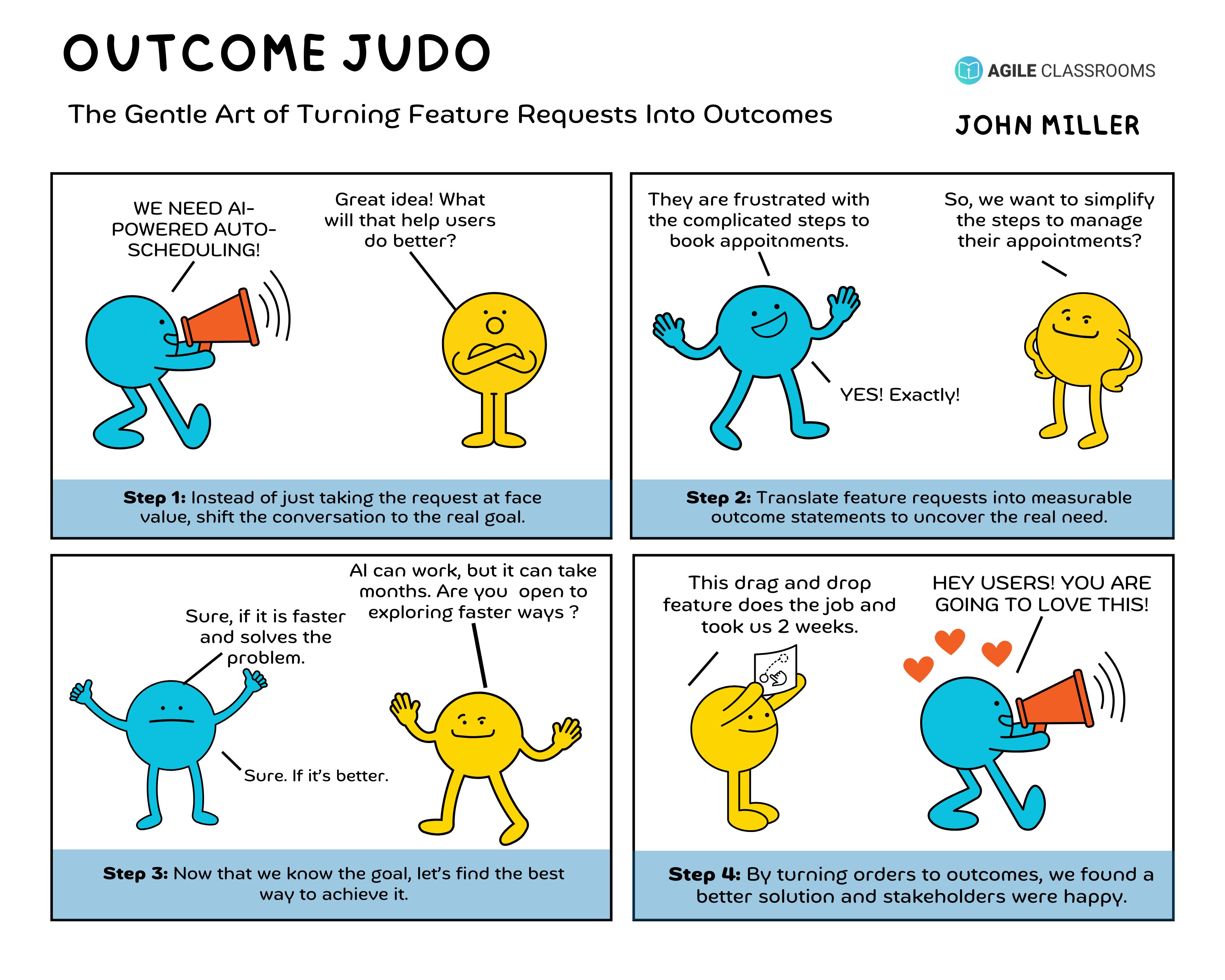
🥋 Step 1: Redirect the request → Shift focus from the feature to the desired outcomes
🥋 Step 2: Define outcome statements → Translate needs into measurable customer outcomes
🥋 Step 3: Explore options → Identify the best way to meet the outcome
🥋 Step 4: Guide the stakeholder → Align on commitment to the outcome, not just the feature
Step 1: Redirect the Request
Instead of accepting the request at face value, the team leans into its energy and asks:
💬 "That’s interesting! What’s the ideal outcome you’re hoping for?"
🔄 The stakeholder’s response:
🗣️ "We want users to walk into a perfectly comfortable home without adjusting the thermostat. It’s about comfort, convenience, and energy efficiency."
💡 Now, we’ve redirected the conversation from the feature to the desired outcomes.
Step 2: Define Outcome Statements
Once the true goal is clear, the team translates it into measurable customer outcomes:
✔ Decrease the time required for a home to reach the optimal temperature upon arrival.
✔ Increase the accuracy of temperature adjustments based on occupancy and usage patterns.
✔ Decrease unnecessary energy consumption while maintaining the desired comfort level.
📌 Why does this matter?
By turning vague desires into clear outcome statements, we can now explore multiple ways to achieve them—not just the requested feature.
📌 Want to learn more about crafting effective outcome statements?
We teach this in our Certified Scrum Product Owner (CSPO) course and cover it in this post: 🔗 Customer Job Maps – Learn More
Step 3: Explore Options
With these outcomes in mind, the team gathers to brainstorm.
They discuss the stakeholder’s machine-learning idea but also explore alternative options, such as geofencing—a simpler, more cost-effective solution.
📌 (Think of geofencing as your phone notifying the thermostat when you're on your way home, adjusting the temperature accordingly!)
💡 The team evaluates each option against the user’s true goal—comfort, convenience, and energy efficiency.
Step 4: Guide the Stakeholder Toward the Best Path
After weighing the possibilities, the team presents their findings:
💬 “We explored multiple technologies, including the machine-learning approach. While it’s promising, we found that geofencing combined with user-set preferences could achieve the same outcome more cheaply. It's simpler, faster, and easier to develop.”
Then comes the key stakeholder alignment move:
👉 "We see why you thought of this feature, and it's a great idea. Would you be open to our team looking at some other options? We might be able to leverage existing capabilities or find a cheaper and faster way to get there. Your idea is definitely an option—would you be open to that?"
🔄 The stakeholder, seeing the thoroughness of the team’s exploration, responds:
🗣️ "That sounds great. Let’s go with that approach!"
💡 At this point, the commitment shifts from a specific solution to the best path forward—ensuring the team stays aligned to outcomes, not just requests.
Conclusion: Why Outcome Judo Works
This process isn't just about saying “no” to feature requests.
It’s about saying “yes” to the right things.
✅ Less waste – Avoiding unnecessary features saves time, money, and effort.
✅ Better solutions – Exploring multiple approaches leads to simpler, smarter, and more cost-effective options.
✅ Stronger stakeholder relationships – Rather than rejecting ideas, teams engage stakeholders in problem-solving, earning their trust.
✅ More successful products – By focusing on outcomes instead of orders, teams build products people actually want and use.
Outcome Judo trains stakeholders to bring problems and needs, not just solutions.
When teams and stakeholders collaborate on defining desired outcomes, they shift from order-takers to problem-solvers—creating products that truly deliver value.
And that’s how you escape the Feature Trap.
A Fun Take on This? Here’s the Outcome Judo Comic!
Want to Master This?
To learn how to apply Outcome Judo to your product decisions, we teach this in our Certified Scrum Product Owner (CSPO) course.
0 comments
PDUS/SEUS
This article counts toward .25 PDUS/CEUS. Get more credits by reading more articles 👉
Enjoyed this post? Let’s keep going.
Whether you're leading a team, managing a product, or transforming a classroom, I have resources to help you work smarter and get real results.
Click below for what works for you:
Free Resources
More Articles
Engaging Workshops
About John
Hey, I’m John. I help leaders, educators, and product innovators work smarter and build things that matter.
I cut through the noise to bring modern methods that actually work. Whether it’s leadership, product management, or education, the goal is the same—less friction, more impact. No fluff. No jargon. Just real-world insights to help you get better, faster.
💡 What You’ll Get Here:
✔ Smarter ways to lead and collaborate without the micromanaging
✔ Fresh, no-nonsense takes on modern work and education
✔ Tools and tactics to make work easier, faster, and more effective
Work doesn’t have to be chaotic.
Let's connect!