Don't Miss an Article
Join thousands of other innovators receiving our newsletter.
Slice Stories Like a Ninja: Agile Tips That Actually Work
- Everyone | .25 PDU/SEU/CEUs
Struggling with oversized stories? Here’s how to deliver faster with less frustration.
Feeling stuck with giant user stories that never seem to get done?
Story slicing isn’t just a skill. It’s how you unlock flow, feedback, and faster value.
Here’s how to slice like a ninja (with examples).
And yes, there’s a free infographic at the end.
1. Stay in Scope
Avoid tangential stories and make sure every slice aligns with the original story’s goal. The key here is focus.
Imagine a sculptor chipping away at a block of marble. Every strike is purposeful, removing only what doesn’t belong.
Example:
🌟 Original story: “Make it easy for users to manage their account settings”
🚫 Out-of-scope slice: “Allow users to sign in via social media”
✅ That’s not a slice—it’s a new story.
2. Right-Size Your Slices
A story slice should be small enough to complete within one iteration—but still useful.
We’re not trying to split the atom here. Your slice should be manageable, not microscopic.
Rules of Thumb:
🔹 Aim to complete 3–5 stories per Sprint (Scrum)
🔹 Each story should take about 2–3 dev days
🔹 Use your Service Level Expectation (SLE) if you track flow
Example:
“Implement a basic search box that returns results from the user’s uploaded files”
✅ Fast to build. Useful on its own.
3. Deliver Usable Functionality
Each slice should produce something that works. If it can deliver full business value on its own, great—but that's not always possible. What matters most is that it's usable, testable, and provides the functionality necessary to reach that value.
Think of a full feature like “Post Content to Website.” That’s valuable—but also big. To make it manageable, we might slice it into: Submit, Review, Approve, and Publish.
Each of those slices is usable. They function. They work. Even if value only emerges when combined, we still make meaningful progress.
Example:
Instead of:
🔻 “Create UI for search”
🔻 “Develop search backend”
Do this:
✅ “Deliver a basic search feature with working UI and backend”
It works. It’s testable. It provides usable functionality.
4. Ensure Independence
Slices should be self-contained, with minimal reliance on other stories. This gives your team the freedom to build, test, and ship in any order—without waiting on upstream work.
If a story must be delivered after another to work, it’s not independent.
⚠️ Dependent Example
Story:
"Build the frontend UI for viewing workout history."
Why it's not independent:
It depends on the backend already being built to store and retrieve workouts
Without that data, the UI is just an empty frame
You can’t test it, validate it, or ship it on its own
It can’t move freely in the backlog or provide user value by itself.
✅ Independent Example
Story:
"Enable users to log and view a workout using a simple form and temporary storage"
✅ Bundles frontend, logic, and lightweight storage together
✅ Delivers actual functionality to the user
✅ Can be delivered before or after any other feature—no blockers
A good test:
Can this story be built, tested, and shipped no matter what else is in place?
If yes, it’s independent. If not, it’s a risk waiting to happen.
Conclusion: Start Slicing Like a Pro
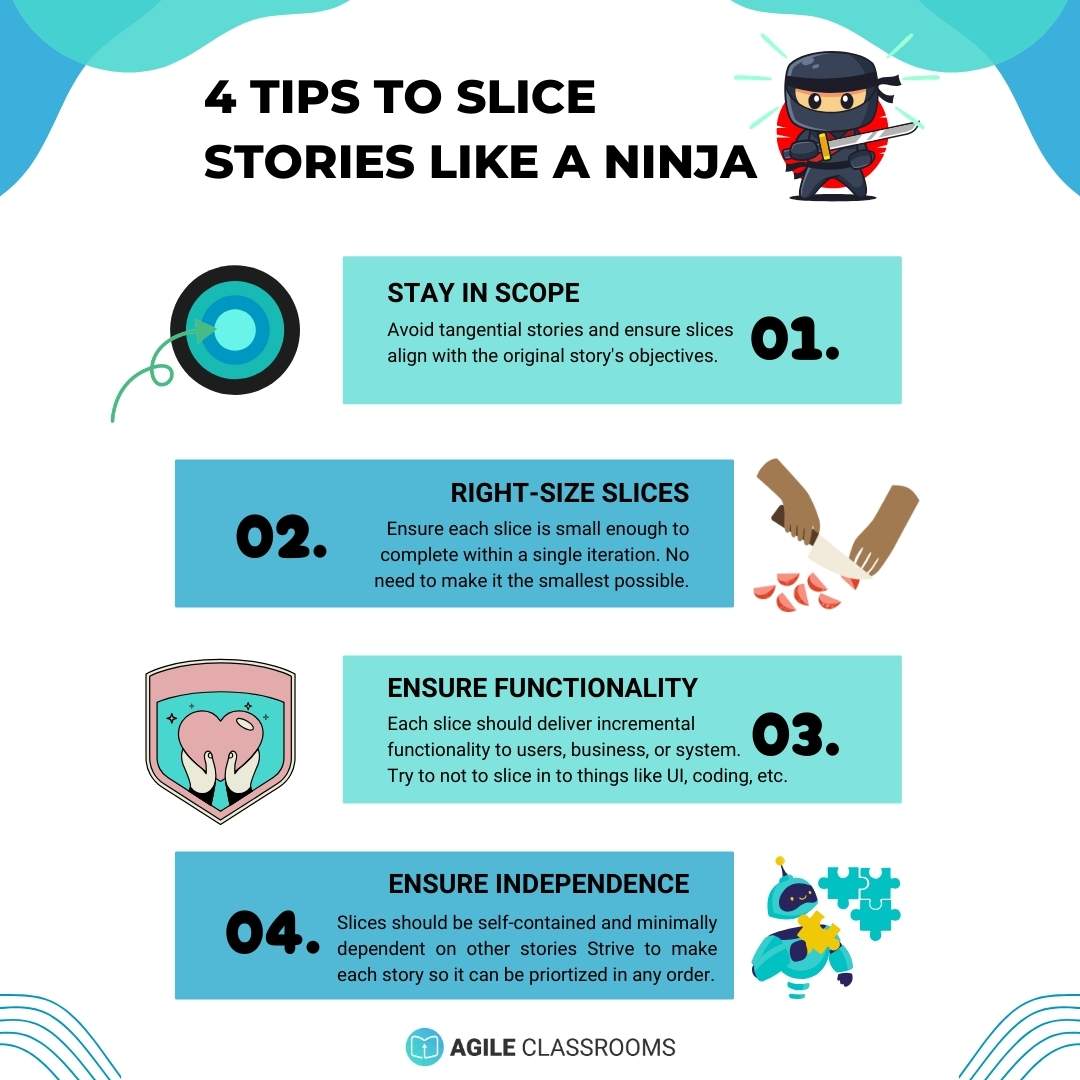
When done right, story slicing keeps your work flowing, your team unblocked, and your users delighted.
✅ Stay in scope
✅ Right-size your stories
✅ Deliver usable functionality
✅ Make slices independent
Want a cheat sheet to keep these tips handy?
👉 Download the Free Infographic
🗓️ Ready to practice slicing in a live setting? Join our Certified Scrum Product Owner (CSPO) workshop for hands-on learning.
Next time you’re handed a watermelon-sized story… slice like a ninja.
Faster flow. Better feedback. Less chaos.
🏅 Earn 0.25 SEUs/PDUs for reading this! Renew your PMP, CSM, or CSPO certification.
PDUS/SEUS
This article counts toward .25 PDUS/CEUS. Get more credits by reading more articles 👉
Enjoyed this post? Let’s keep going.
Whether you're leading a team, managing a product, or transforming a classroom, I have resources to help you work smarter and get real results.
Click below for what works for you:
Free Resources
More Articles
Engaging Workshops
About John
Hey, I’m John. I help leaders, educators, and product innovators work smarter and build things that matter.
I cut through the noise to bring modern methods that actually work. Whether it’s leadership, product management, or education, the goal is the same—less friction, more impact. No fluff. No jargon. Just real-world insights to help you get better, faster.
💡 What You’ll Get Here:
✔ Smarter ways to lead and collaborate without the micromanaging
✔ Fresh, no-nonsense takes on modern work and education
✔ Tools and tactics to make work easier, faster, and more effective
Work doesn’t have to be chaotic.
Let's connect!