Don't Miss an Article
Join thousands of other innovators receiving our newsletter.
The Product Increment Matrix
- John Miller
Overview
Incremental development ≠ frequent releases. You can build incrementally but release infrequently (or vice versa).
The Product Increment Matrix helps teams understand different approaches to development and release.
-
Four quadrants:
Flow 🌊 (Incremental + Frequent): Continuous small updates (e.g., SaaS, adaptive learning).
Staged 🚂 (Incremental + Infrequent): Regular scheduled releases (e.g., enterprise software, education updates).
Intermittent 🚛 (Non-Incremental + Frequent): Larger structured phases, but released periodically (e.g., finance, retail).
Big Bang 🚀 (Non-Incremental + Infrequent): Large phases, released all at once (e.g., aerospace, full curriculum overhauls).
Choosing the right approach depends on industry constraints, customer expectations, and operational factors.
Introduction
One of the biggest misconceptions in product development and project management is that incremental development always means frequent releases. While approaches like Agile and Lean encourage small, iterative progress, that doesn’t always translate to continuous deployment.
Some teams build incrementally but release in larger, scheduled batches, while others develop in big phases and launch periodically.
To help teams better understand how development and release strategies differ, I created the Product Increment Matrix to help explain it . This model maps how products and services are developed (incrementally or in large phases) against how they are released (frequently or in larger launches).
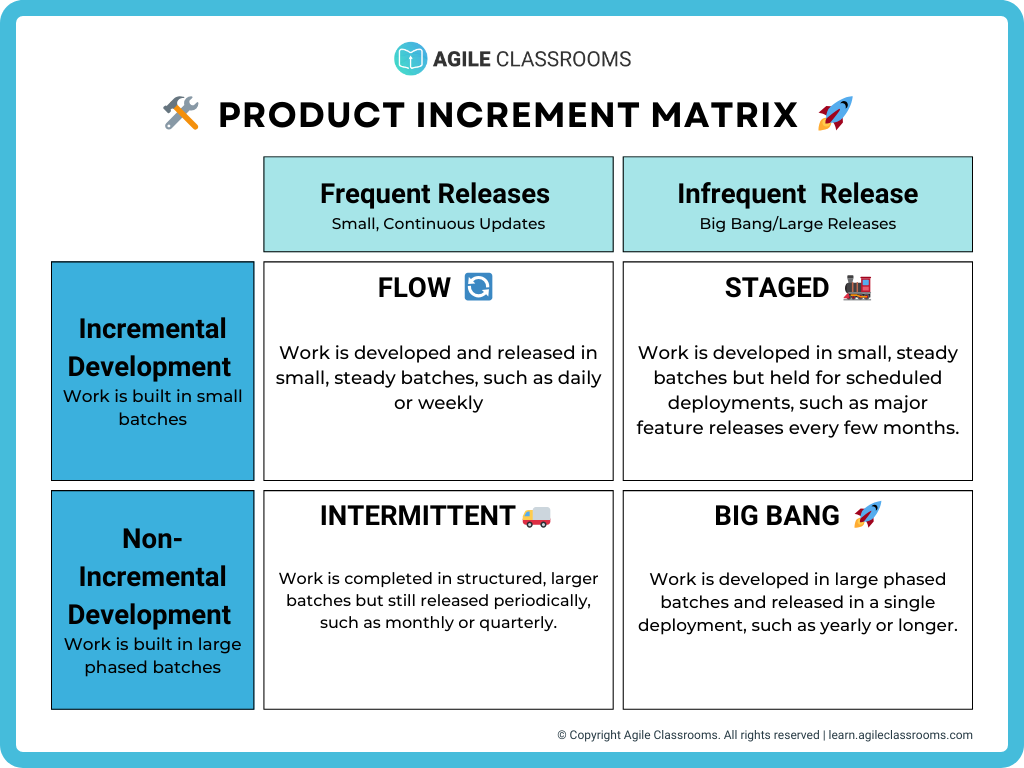
The Product Increment Matrix helps teams understand different approaches to development and release strategies across industries.
Understanding the Four Approaches to Development & Release
1. Flow (Incremental + Frequent) 🌊
Development Style: Work is built in small, steady batches.
Release Style: Work is deployed frequently, such as daily or weekly updates.
-
Example Industries:
Software & Tech: SaaS applications with continuous deployment.
Media: News websites publishing stories incrementally.
Education: Teachers iteratively refine lesson plans and adjust instruction daily or weekly based on student needs.
2. Staged (Incremental + Infrequent) 🚂
Development Style: Work is built in small, steady batches.
Release Style: Work is held for scheduled deployments, such as quarterly releases.
-
Example Industries:
Software & Tech: Major enterprise software updates (e.g., ERP updates).
Healthcare: Medical research published in periodic journals.
Education: School districts develop and refine professional development programs throughout the year but roll them out in scheduled training sessions.
3. Intermittent (Non-Incremental + Frequent) 🚛
Development Style: Work is completed in larger structured phases.
Release Style: Work is released periodically, such as monthly or quarterly updates.
-
Example Industries:
Finance: Regulatory compliance systems updated in quarterly releases.
Telecommunications: Network firmware updates on set schedules.
Retail: Seasonal product launches (e.g., new fashion collections).
4. Big Bang (Non-Incremental + Infrequent) 🚀
Development Style: Work is developed in large phased batches.
Release Style: Work is deployed all at once, such as yearly or longer.
-
Example Industries:
Aerospace: Launching a new aircraft model.
Automotive: Releasing a new vehicle generation.
Education: A full curriculum overhaul every several years.
Choosing the Right Approach
The best approach depends on several factors:
Industry Constraints – Hardware, medical, and regulated industries often require infrequent releases due to compliance needs.
Customer Expectations – SaaS products often favor continuous updates, while enterprise clients may prefer predictable, scheduled releases.
Operational Considerations – Some teams struggle with the infrastructure needed for frequent releases and may prefer larger, less frequent launches.
Clarifying Questions
1. Does Incremental Always Mean Small Batches?
Yes, in this matrix, incremental development means building in small, independently usable batches rather than waiting for a full-phase completion. However, in some industries, "incremental" may mean larger milestone-based progressions.
2. Do All Organizations Fit Neatly Into a Quadrant?
Not always. The quadrants might appear rigid, but the intent is to show that there are different approaches to incremental and non-incremental methods. In reality, there are degrees of each category, and some organizations may blend elements of multiple quadrants.
3. Are These Industry Examples the Best Approach for Each?
Not necessarily. The industries listed are just examples of typical approaches, not strict rules. Many industries could benefit from a different quadrant than what is common practice today. For instance, some aerospace projects could move toward more incremental development, and some financial systems could benefit from more frequent releases. The matrix is meant to describe patterns, not prescribe solutions.
4. Are You Saying One Approach Is Better Than the Others?
No. While incremental development is often a more flexible approach, different industries and projects have different constraints. There are many paths up the mountain, and what works best depends on the specific context, industry, and goals of an organization.
5. Why Do You Use “Launch” Instead of “Release”?
"Release" is more common in software, while "launch" is a broader term used in product introductions, curriculum rollouts, policy implementations, and more. We chose "launch" to make the matrix more applicable beyond software teams.
6. Are the Timeframes in the Matrix Strict Rules?
No. The timeframes (e.g., daily, weekly, quarterly, yearly) are just examples of typical ranges, not rigid classifications. The matrix is meant to help identify patterns and clear up misconceptions that incremental development always means releasing frequently, not impose hard rules.
Final Thoughts
The Product Increment Matrix helps teams understand different development and release strategies. Whether you're in tech, education, healthcare, or manufacturing, recognizing where your approach fits ensures better decision-making.
For product managers and business leaders, understanding how to build and launch products effectively is crucial. If you’re looking to deepen your skills in outcome-led product management, the Certified Scrum Product Owner (CSPO) course covers how to prioritize, incrementally deliver value, and align development with real customer needs.
👉 Learn more about the Certified Scrum Product Owner (CSPO) course here.
🚀 Where does your team fit in the matrix? How do you approach development and releases? Let’s discuss in the comments!
PDUS/SEUS
This article counts toward .25 PDUS/CEUS. Get more credits by reading more articles 👉
Enjoyed this post? Let’s keep going.
Whether you're leading a team, managing a product, or transforming a classroom, I have resources to help you work smarter and get real results.
Click below for what works for you:
Free Resources
More Articles
Engaging Workshops
About John
Hey, I’m John. I help leaders, educators, and product innovators work smarter and build things that matter.
I cut through the noise to bring modern methods that actually work. Whether it’s leadership, product management, or education, the goal is the same—less friction, more impact. No fluff. No jargon. Just real-world insights to help you get better, faster.
💡 What You’ll Get Here:
✔ Smarter ways to lead and collaborate without the micromanaging
✔ Fresh, no-nonsense takes on modern work and education
✔ Tools and tactics to make work easier, faster, and more effective
Work doesn’t have to be chaotic.
Let's connect!