Don't Miss an Article
Join thousands of other innovators receiving our newsletter.
Conjunction Junction: Simplify User Story Splitting with Grammar
- Everyone | .25 PDU/SEU/CEUs
Introduction
Have you ever faced the challenge of slicing user stories into small enough slices that fit into a sprint or a few days of team effort? If so, you're not alone.
During my several years coaching at Scrum Alliance, many of the teams we worked with weren’t doing software. They shared that they struggled to make their user stories small enough to fit into a sprint. Since many of these teams weren’t building software, I think much of the problem was that most of the advice out there was centered around software development. The examples and patterns didn’t translate easily to their work.
To help, Simon Orrell, my fellow coach, offered to organize a short workshop on story slicing. We invited the teams to bring in some of their user stories that they were having trouble splitting, and we would coach them through the process.
I brought a few well-known patterns for them to learn and see which ones might apply. We discussed Richard Lawrence’s Story Slicing diagram and Mike Cohn’s S.P.I.D.R. patterns. These are excellent tools, but what I learned by watching Simon became my favorite technique that I now use almost all the time.
It is more intuitive than the others, easier to learn, and a single technique versatile enough to cover most of the other patterns—only simpler. We call it the Conjunction Junction pattern, and it's about to transform the way you approach slicing user stories.
Discovering a More Intuitive Approach
In the workshop, one team shared one of their user stories. Simon wrote this up on the whiteboard:
"As a Guide, I want to post content on the SA site so that I can help more people with Scrum."
Simon then, as a great coach tends to do, asked questions. His questions were very focused on words in the user story.
Here’s how Simon used the approach to coach this user story in real time:
“Guide” (noun – persona)
Guide is a noun. Nouns often represent people, roles, or objects—categories we can slice into.
He circled the word Guide and asked, "Are there different kinds of Guides?"
In Scrum Alliance, a guide-level certificate includes Certified Coaches and Certified Trainers. This helps to identify different personas within the user story.
Split Stories:
As a Certified Coach…
As a Certified Trainer…
He then asked if they had different needs around posting content. Let’s pretend they said yes. Coaches cared about X, and Trainers cared more about Y. This was a possible split to consider, but then he moved on.
They chose not to use the persona split (Trainer vs. Coach), but it was a worthwhile question to ask. Simon wasn’t assuming it would lead to a slice—he was exploring potential edges. His goal was to find the right places to slice, not to force a split where it didn’t add value.
“Post” (verb – workflow)
Post is a verb. Verbs suggest sequences or actions—great for workflow-based slicing.
He circled the word post and then asked, "What are the steps to post content?"
The team replied: submitting content, reviewing content, making approval decisions, gathering feedback, and publishing content.
Split Stories:
Trainer submits content.
Scrum Alliance reviews content.
Scrum Alliance decides whether to approve content.
Trainer receives feedback on content.
Scrum Alliance publishes content.
“Content” (noun – type)
Content is a noun. Different types of content offer natural categories to split by.
Next, he circled the word content and asked, "What types of content are there that they want to post?"
They listed: mini-lessons, articles, webinars.
Split Stories:
Mini-lessons
Articles
Webinars
In just minutes, the team had multiple, manageable stories they could start working on right away.
They chose not to use the persona split (Trainer vs. Coach). Instead, they sliced it first by content type and then by post workflow steps.
For example:
Articles: submit, review, feedback, approve, publish
Mini-Lessons: submit, review, feedback, approve, publish
What they ended up doing was combining two dimensions: they first split by content type (articles, mini-lessons), then by the workflow steps (submit, review, approve, etc.).
They came in thinking the story couldn’t be broken down—and left with 12 smaller, usable stories in just minutes.
Why The Name 'Conjunction Junction'
Simon’s knack for simplifying things was inspiring. Unlike my approach, which took a good amount of time to learn each pattern, identify the one that fits, and use it, Simon's approach was so intuitive that they were able to slice it from one to 10 smaller stories in about 5 minutes.
When I asked him what his approach was called, he replied, “I don’t know, I just do it.” So, I named it Conjunction Junction, inspired by the Schoolhouse Rock! cartoon many of us remember from childhood.
The line, "What's your function?" fits perfectly—because the goal is to vertically slice stories so they result in something that is usable and functional.
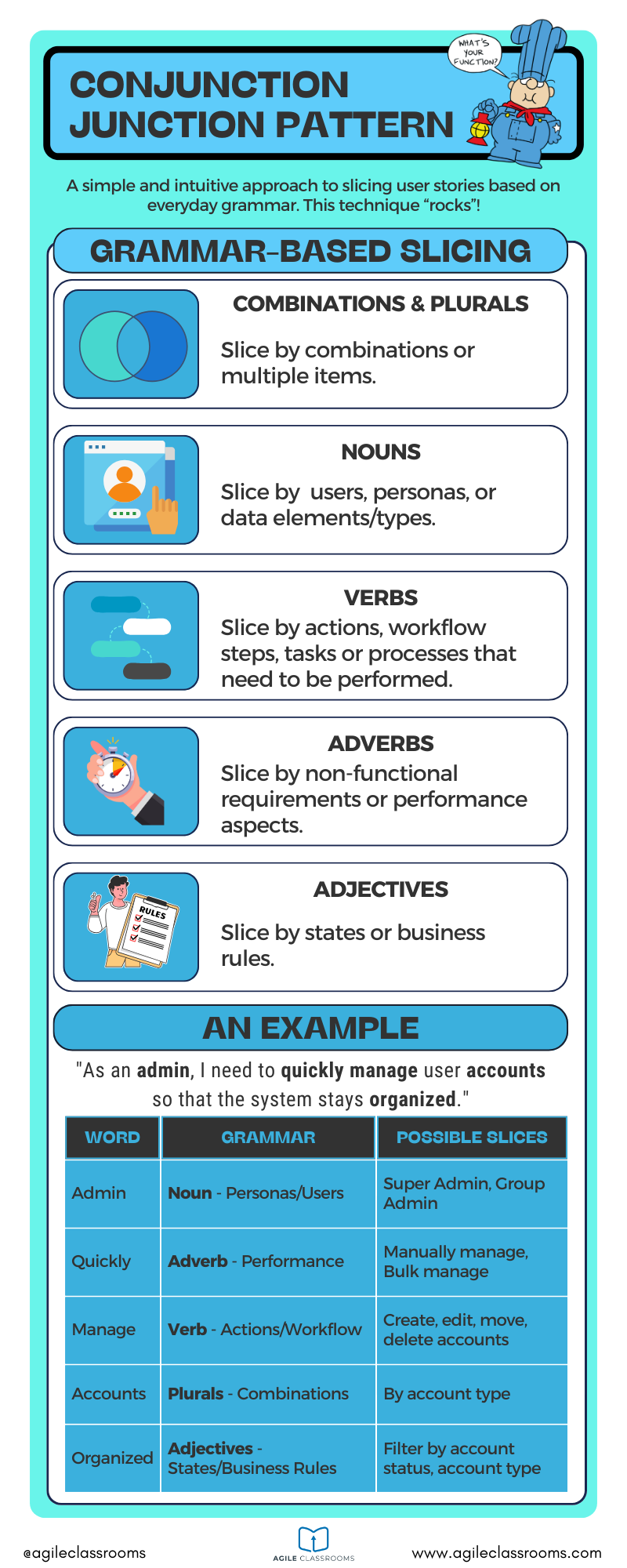
Look for these grammar clues in your user stories to spot natural split points:
'and' / plurals — combinations
verbs — actions, workflow
adverbs — non-functional requirements, performance
nouns — user persona, data elements
-
adjectives — states, business rules
Putting It into Practice
Here’s another example Simon laid out during a CSPO course we taught together:
"As a Marketing/Sales Manager/Analyst, I need to be able to quickly create various reports so that I have insight into client trends and team performance."
Using the Conjunction Junction pattern:
“Marketing/Sales Manager/Analyst” (noun – persona)
These are nouns representing user roles—each role can be sliced into its own story.
As a Marketing Manager…
As a Sales Manager…
As an Analyst…
“Create” (verb – workflow)
These verbs show the steps involved—ideal for slicing by action.
“What are the steps to create reports?”
Submit data for reports.
Process data to generate reports.
Review generated reports.
Finalize and approve reports.
Distribute reports to stakeholders.
“Quickly” (adverb – performance)
Adverbs indicate performance requirements—these affect how the story behaves.
"quickly" — start slow, then improve performance
Manually generate reports with basic data.
Automatically generate reports with some manual steps.
Automatically generate reports quickly.
“Various Reports” (plural – combinations)
Plurals often imply multiple types or categories—great for breaking out variations.
"various reports" — types
Client satisfaction reports
Weekly sales trend reports
Monthly performance reports
By using the Conjunction Junction pattern, we broke down this complex story into smaller, actionable tasks that each role could focus on, ensuring clarity and manageability.
The Power of Simplicity
What makes the Conjunction Junction pattern so powerful is its simplicity. By analyzing the grammar of your user stories, you gain immediate insights into potential splits.
This method is not only easy to learn but also incredibly effective in practice.
While other splitting patterns like SPIDR (Spike, Path, Interface, Data, Rules) or Richard Lawrence’s Story Slicing sheet offer structured approaches, the Conjunction Junction pattern covers all bases without the need to memorize multiple techniques. It’s accessible to everyone.
Thank you to Simon Orrell for introducing me to this technique.
Conclusion
The Conjunction Junction pattern stands out as a straightforward and effective method for splitting user stories. By focusing on the grammar of user stories, this technique provides a simple yet powerful way to create functional and usable tasks.
Embrace the Conjunction Junction pattern, and you’ll find that creating actionable user stories is not just achievable but also intuitive and enjoyable.
Want hands-on practice with the Conjunction Junction slicing technique—and others like it?
Join our Certified Scrum Product Owner (CSPO) course where you’ll learn how to lead with outcomes, slice stories with clarity, and build products that truly matter.
🏅 Earn 0.25 SEUs/PDUs for reading this.
0 comments
PDUS/SEUS
This article counts toward .25 PDUS/CEUS. Get more credits by reading more articles 👉
Enjoyed this post? Let’s keep going.
Whether you're leading a team, managing a product, or transforming a classroom, I have resources to help you work smarter and get real results.
Click below for what works for you:
Free Resources
More Articles
Engaging Workshops
About John
Hey, I’m John. I help leaders, educators, and product innovators work smarter and build things that matter.
I cut through the noise to bring modern methods that actually work. Whether it’s leadership, product management, or education, the goal is the same—less friction, more impact. No fluff. No jargon. Just real-world insights to help you get better, faster.
💡 What You’ll Get Here:
✔ Smarter ways to lead and collaborate without the micromanaging
✔ Fresh, no-nonsense takes on modern work and education
✔ Tools and tactics to make work easier, faster, and more effective
Work doesn’t have to be chaotic.
Let's connect!