Don't Miss an Article
Join thousands of other innovators receiving our newsletter.
Reimagining Backwards Design with Agile
- K12 Edu | .25 PDU/SEU/CEUs
How Agile Classrooms Brings Each Step to Life Through Iteration, Visibility, and Student Voice
Backwards Design is a go-to strategy for many teachers. You start with the end in mind: define learning goals, determine evidence of success, and plan backwards from there. But even with this clarity, plans often get stuck.
Students don’t always progress linearly. Projects evolve. Engagement drops. And traditional plans rarely keep up.
That’s where Agile Classrooms comes in.
Agile Classrooms doesn’t replace Backwards Design—it amplifies it and integrates it.
Instead of static unit plans, Agile uses Learning Sprints: short cycles that organize learning around student-visible goals, participation, and adaptability.
Let’s explore how Agile Classrooms brings each step of Backwards Design to life through two core routines: Refinement and Planning.
Step 1: Define the Learning Goals—Refining the Learning Backlog
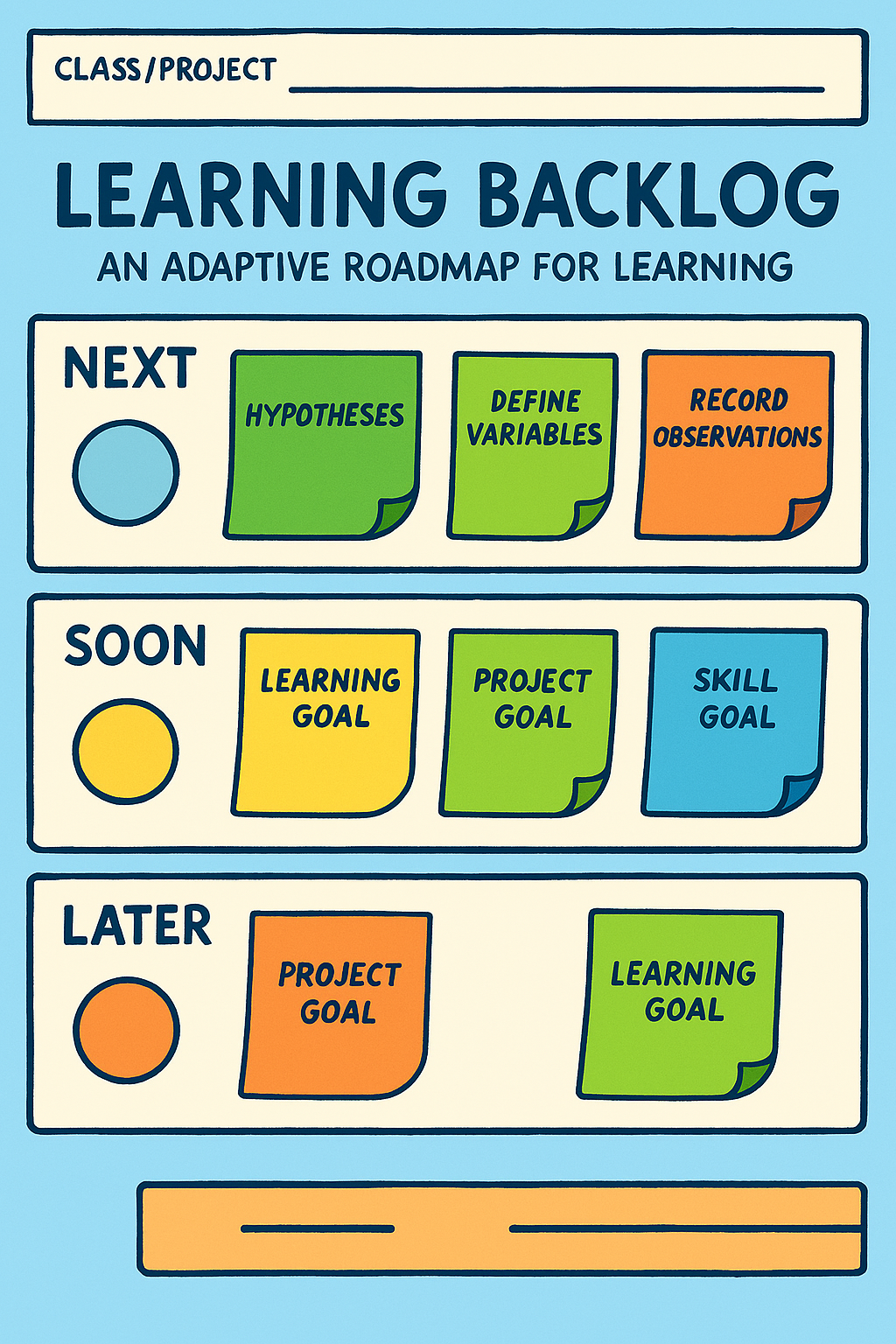
In Backwards Design, the first step is defining what students should know or be able to do. In Agile Classrooms, we call this the Learning Backlog.
Think of it as a dynamic playlist of learning goals. Not fixed. Not rigid. Continuously refined.
During the Refinement Routine, teachers and students:
Clarify and break down goals
Prioritize what's most important now
Make learning visible for everyone
Example: A goal like "Design an experiment" becomes a backlog of specific, doable steps:
Formulate a hypothesis
Define variables
Record observations
Each goal is mapped to planning horizons like Next, Soon, or Later—making it easier to adapt as students progress.
Step 2: Determine Evidence of Learning—Adding Success Criteria
Once goals are clear, the next step is defining how students will demonstrate success.
In Agile Classrooms, every goal in the Learning Backlog includes Success Criteria, co-created with students during Refinement.
Example: For "Formulate a Hypothesis," success looks like:
Clear
Testable
Predicts an outcome
Students know what "done" looks like. And more importantly, they help define it.
This builds accountability and boosts clarity without adding control.
Agile Classrooms also integrates evidence of learning throughout the Sprint, not just at the end. Check-ins, Reviews, and Retrospectives all provide valuable moments to reflect on progress, gather feedback, and adapt learning strategies. These informal assessments help teachers and students stay aligned and adjust as needed—beyond just grades.
Step 3: Plan the Learning—Using the Planning Routine and Learning Canvas
Once we know what we want to achieve and what evidence we need to assess, it's time to plan the path.
Agile Classrooms uses the Planning Routine to translate each goal into manageable, visible actions.
Educators can even anchor each Learning Sprint around an enduring understanding—a big idea that guides the unit.We call this the Learning Sprint Goal, it gives students purpose, direction, and a reason to care.
Let’s take the same example: "Formulate a Hypothesis."
In Planning, students:
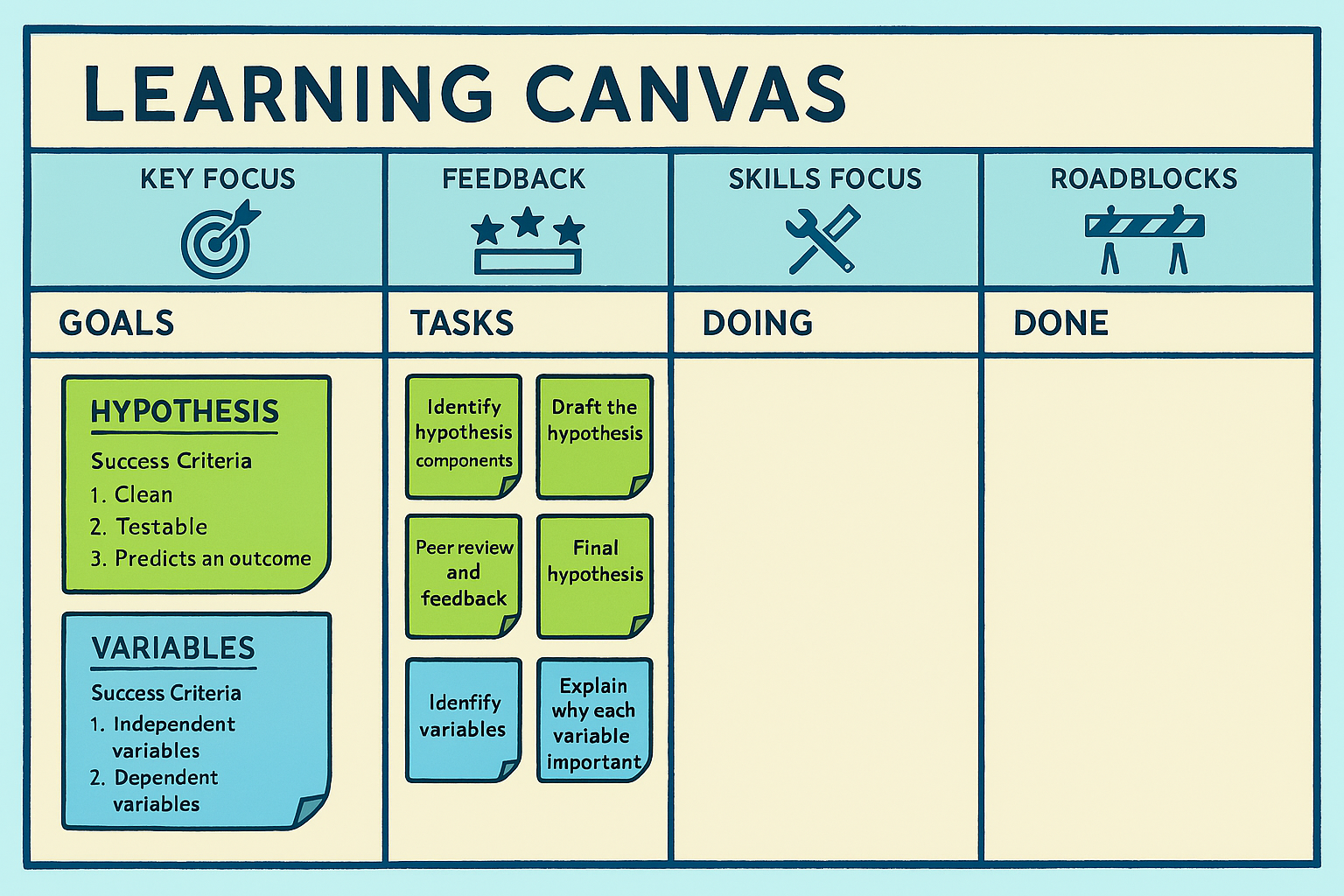
Identify parts of a hypothesis
Brainstorm ideas
Draft and refine their hypothesis
Review with peers using the success criteria
The Learning Canvas maps these tasks visually, so students can track what they’re working on, what’s next, and how their work connects to learning goals.
🔗 Planning Protocol
🔗 Agile Learning Canvas
How Agile Classrooms Enhances Backwards Design
Agile Classrooms strengthens the foundation of Backwards Design with four core principles:
1. Iterative Learning
Students work in short sprints, constantly reflecting and adapting.
2. Incremental Steps
Big goals become small wins. Students see progress and stay motivated.
3. Participative Involvement
Using the Spectrum of Choice, students gain more autonomy over time.
🔗 Spectrum of Choice Infographic
4. Visualization
The Learning Canvas, Planning Routine, and the Learning Backlog make learning paths visible.
Try It in Your Classroom
Want to make Backwards Design more participative and adaptable? Explore our full set of Agile for Educators resources to see how teachers are applying these tools in real classrooms.
Start with these two routines:
Ready to go deeper?
👉 Join an ACT Workshop to get certified and bring Agile Classrooms to life in your school.
🏅 Earn 0.25 SEUs/PDUs/CEus for reading this!
0 comments
PDUS/SEUS
This article counts toward .25 PDUS/CEUS. Get more credits by reading more articles 👉
Enjoyed this post? Let’s keep going.
Whether you're leading a team, managing a product, or transforming a classroom, I have resources to help you work smarter and get real results.
Click below for what works for you:
Free Resources
More Articles
Engaging Workshops
About John
Hey, I’m John. I help leaders, educators, and product innovators work smarter and build things that matter.
I cut through the noise to bring modern methods that actually work. Whether it’s leadership, product management, or education, the goal is the same—less friction, more impact. No fluff. No jargon. Just real-world insights to help you get better, faster.
💡 What You’ll Get Here:
✔ Smarter ways to lead and collaborate without the micromanaging
✔ Fresh, no-nonsense takes on modern work and education
✔ Tools and tactics to make work easier, faster, and more effective
Work doesn’t have to be chaotic.
Let's connect!