Don't Miss an Article
Join thousands of other innovators receiving our newsletter.
Why 21st Century Skills Matter More Than Ever
- K12 Educators | Leaders | .1 PDU/SEU
Key Takeaways
The 4Cs of 21st Century Skills—Creativity, Collaboration, Critical Thinking, and Communication—are no longer optional. They are essential for navigating a world defined by competition, rapid change, global connectedness, and growing complexity.
AI, automation, and digital platforms are making knowledge alone less valuable. What matters now is the ability to think, create, collaborate, and solve complex problems.
This shift affects education, business leadership, and the skills organizations seek.
The 4Cs: Essential Skills for the Future
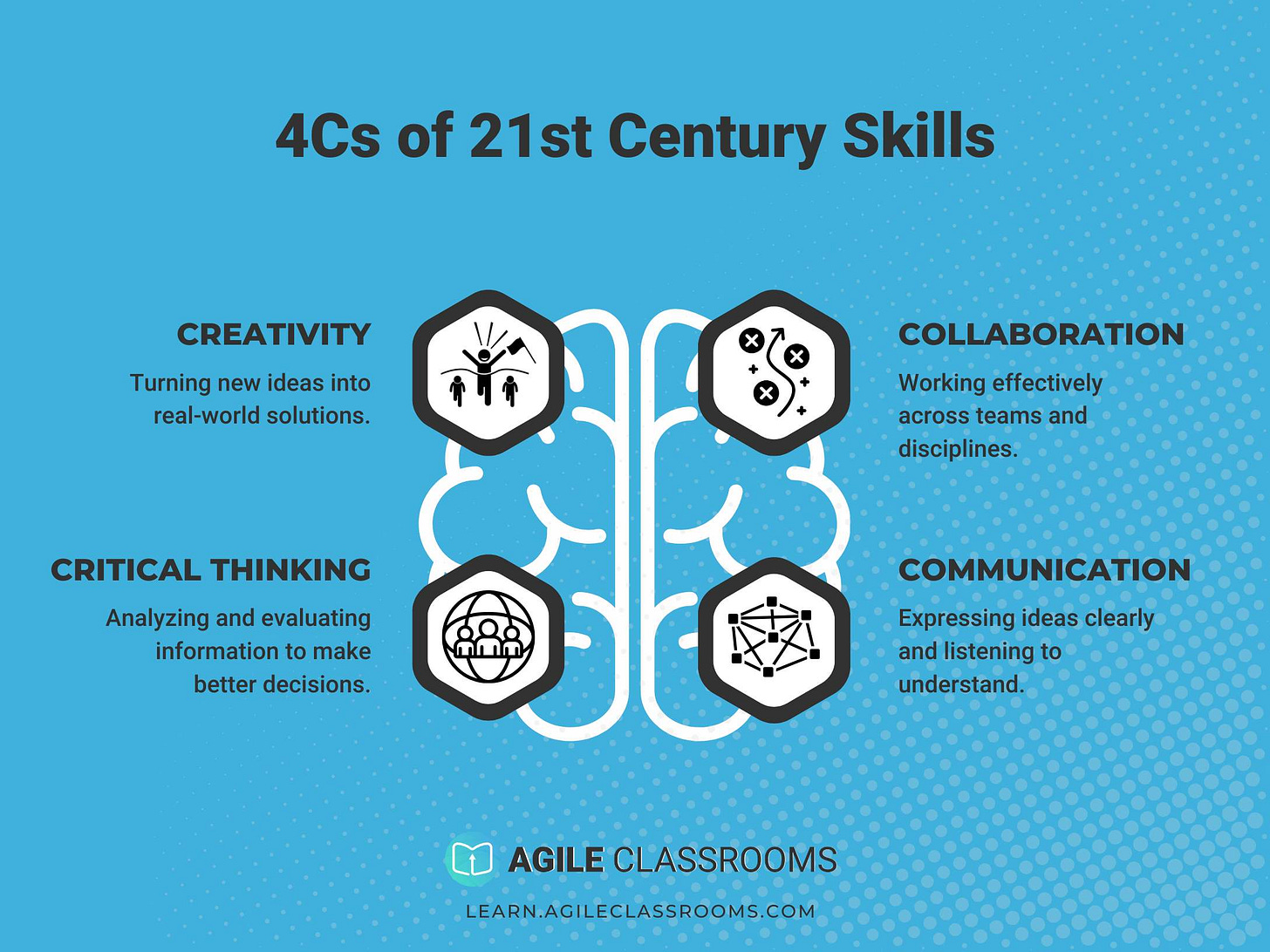
The 4Cs—Creativity, Collaboration, Critical Thinking, and Communication—are essential skills needed to thrive in a world defined by rapid change, automation, and global interconnectedness.
Employers aren’t hiring based on what you know. With AI and Google at our fingertips, knowledge is abundant and accessible to all. They're hiring based on what you can do with what you know.
That’s why the 4Cs of 21st Century Skills—Creativity, Collaboration, Critical Thinking, and Communication—are more than just education buzzwords. They are the foundation of success, especially in a world where AI has made knowledge a commodity.
Creativity: Turning new ideas into real-world solutions.
Collaboration: Working effectively across teams and disciplines.
Critical Thinking: Analyzing and evaluating information to make better decisions.
Communication: Expressing ideas clearly and listening to understand.
But why do these skills matter more today than ever before? The answer lies in four powerful forces reshaping education and work: Competition, Change, Connectedness, and Complexity.
The World No Longer Rewards Knowledge—It Rewards What You Can Do With It
Technology has leveled the playing field. A startup with a laptop can now disrupt entire industries, something that once required massive investment, infrastructure, and years of effort.
Once, you needed a factory to manufacture products. Now, you can buy a 3D printer and start prototyping from your garage.
A neighborhood shop once had a monopoly. Now, a solo entrepreneur anywhere in the world can build an online store, leverage Amazon, Shopify, and AI-driven marketing, and outcompete them.
A filmmaker once needed an entire studio, expensive cameras, and a production team. Now, someone with an iPhone and TikTok can reach millions overnight.
AI is replacing traditional gatekeepers. It used to take years to break into writing, design, or coding. Now, a teenager using ChatGPT, Midjourney, and no-code tools can launch a business in a weekend.
The result? Competition is fiercer, change is faster, and knowledge alone is no longer enough. Success depends on what you can create, how you adapt, and how well you collaborate with others—skills that AI cannot replace.
This doesn’t just affect students preparing for the workforce. It affects companies, leaders, and professionals who need to continuously adapt to stay ahead.
The 4Cs Behind the 4Cs: What’s Driving This Change?
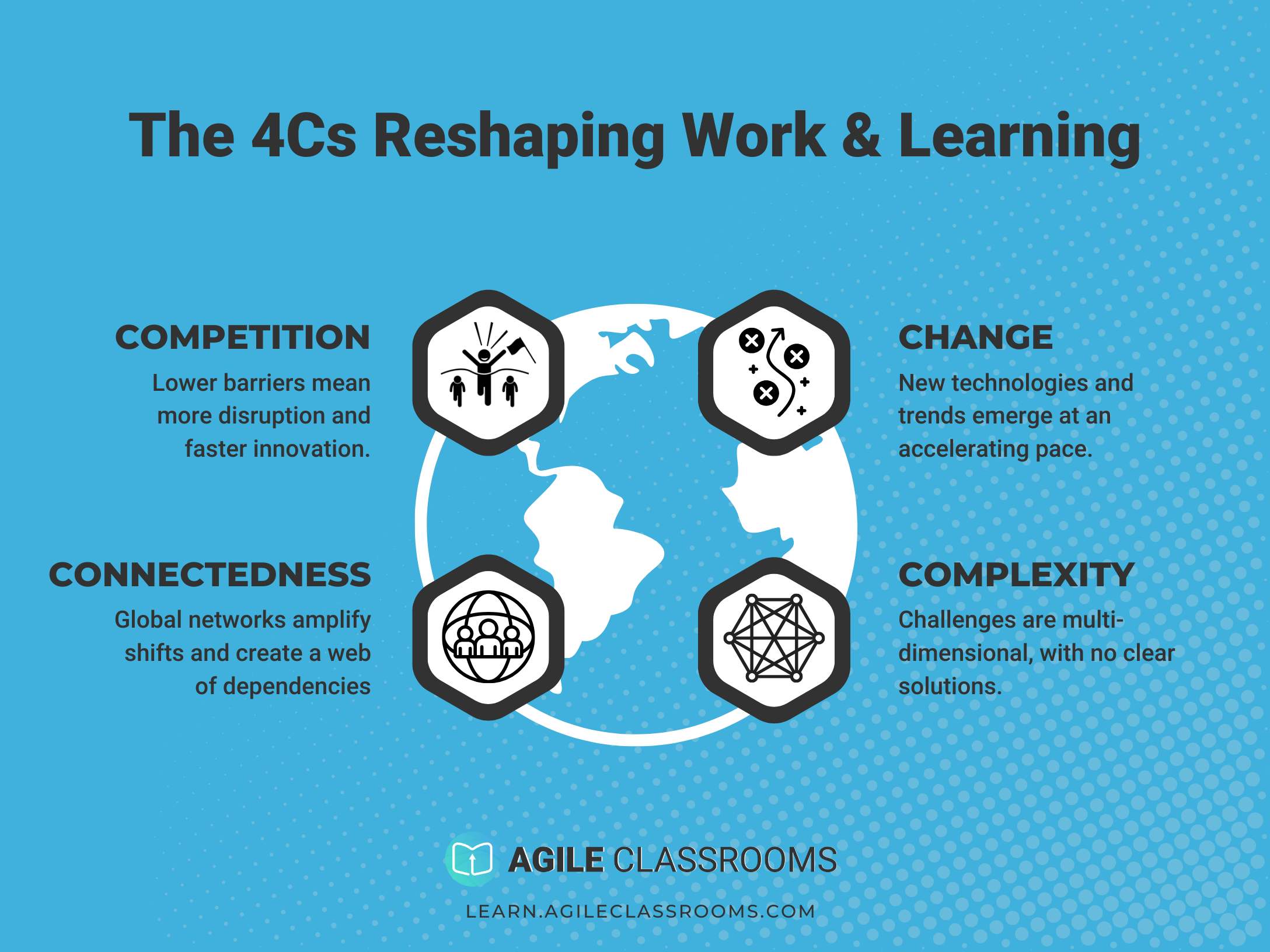
Competition, Change, Connectedness, and Complexity are reshaping work and learning, making adaptability and critical thinking more crucial than ever.
The demand for 21st-century skills isn’t random. It comes from four global forces reshaping work and life. These forces don’t just exist separately. They amplify each other, making adaptability and critical thinking more valuable than ever.
Competition: The Power Has Shifted
It used to take millions of dollars to launch a company. Now, it takes a laptop and an internet connection.
Airbnb didn’t build hotels, but it disrupted the hotel industry.
Uber didn’t buy cars, but it changed transportation forever.
TikTok didn’t own studios, but it became bigger than Hollywood.
Industries that once had high barriers to entry are now being transformed by individuals, small teams, and AI-driven automation.
The same applies to job seekers. A degree no longer guarantees employment. What matters is how well you can solve problems, work with others, and think creatively. AI and automation are replacing predictable work faster than ever.
Companies aren’t just looking for technical expertise. They need employees who can think critically, work in diverse teams, and adapt to new challenges.
But competition doesn’t exist in isolation. It fuels change. As industries transform, companies must constantly evolve or risk becoming obsolete.
Change: The Only Constant
The half-life of knowledge is shrinking. What was cutting-edge five years ago may already be outdated. AI is accelerating that cycle even further.
A software developer who doesn’t keep up with new programming languages may find their skills obsolete within a decade.
A marketer trained in traditional advertising who ignores digital platforms like TikTok and AI-driven analytics will fall behind.
Doctors, lawyers, and even artists are seeing AI reshape their industries, making lifelong learning essential.
But change doesn’t happen in a vacuum. It is amplified by connectedness. A new invention, economic shift, or crisis on one side of the world can trigger massive ripples in industries across the globe.
Businesses and schools alike must prepare people for a future where learning never stops.
Lifelong learning and critical thinking are now survival skills.
Connectedness: A Borderless World
The world is more connected than ever. This opens opportunities but also creates new challenges.
A coder in India, a designer in Brazil, and a CEO in the U.S. can work together in real time on a startup.
A protest in one country can spark economic and political shifts across continents.
A global supply chain issue, like a chip shortage in Taiwan, can disrupt businesses around the world.
Small changes can have massive, unpredictable consequences globally.
Complex global challenges demand adaptable, collaborative teams.
Complexity: The Rise of Wicked Problems
Not all problems are the same. Some are simple problems, difficult but rule-based.
Building bridges
Filing taxes
Learning structured skills
Today’s critical challenges are wicked problems—complex, unpredictable, and multi-dimensional:
Climate change
Misinformation
Global health
Solutions emerge from diverse, multi-skilled teams working collaboratively.
Critical thinking, collaboration, and adaptability are key to solving wicked problems.
Final Thoughts: The Need for Agility
The world has changed. Success now depends on how well we can think, adapt, and collaborate.
AI can answer questions, but it cannot ask the right ones. It can process data, but it cannot create new ideas. The future belongs to those who can think critically, adapt, and collaborate.
Agile and iterative approaches prepare teams for success by fostering:
Adaptability
Iterative learning
Collaboration
Organizations that embrace these approaches will thrive.
How are you preparing yourself and the next generation for a world that demands creativity, critical thinking, collaboration, and communication?
Enjoyed this post? Let’s keep going.
Whether you're leading a team, managing a product, or transforming a classroom, I have resources to help you work smarter and get real results.
Click below for what works for you:
Free Resources
More Articles
Engaging Workshops
About John
Hey, I’m John. I help leaders, educators, and product innovators work smarter and build things that matter.
I cut through the noise to bring modern methods that actually work. Whether it’s leadership, product management, or education, the goal is the same—less friction, more impact. No fluff. No jargon. Just real-world insights to help you get better, faster.
💡 What You’ll Get Here:
✔ Smarter ways to lead and collaborate without the micromanaging
✔ Fresh, no-nonsense takes on modern work and education
✔ Tools and tactics to make work easier, faster, and more effective
Work doesn’t have to be chaotic.
Let's connect!