Don't Miss an Article
Join thousands of other innovators receiving our newsletter.
The Hidden Costs of the 4 Detrimental Delayers in Projects and Products
- Everyone | .25 PDU/SEU/CEUs
Delays are the nemesis of any product or project team.
They disappoint stakeholders, inflate budgets, and drain morale.
While it's easy to blame poor planning or bad estimates, a deeper cause often hides beneath the surface.
Meet the 4 Detrimental Delayers
These hidden blockers—Distractions, Dependencies, Decision Latency, and Debt—are the real culprits that quietly slow you down.
Understanding and managing these four can transform your team's flow and effectiveness.
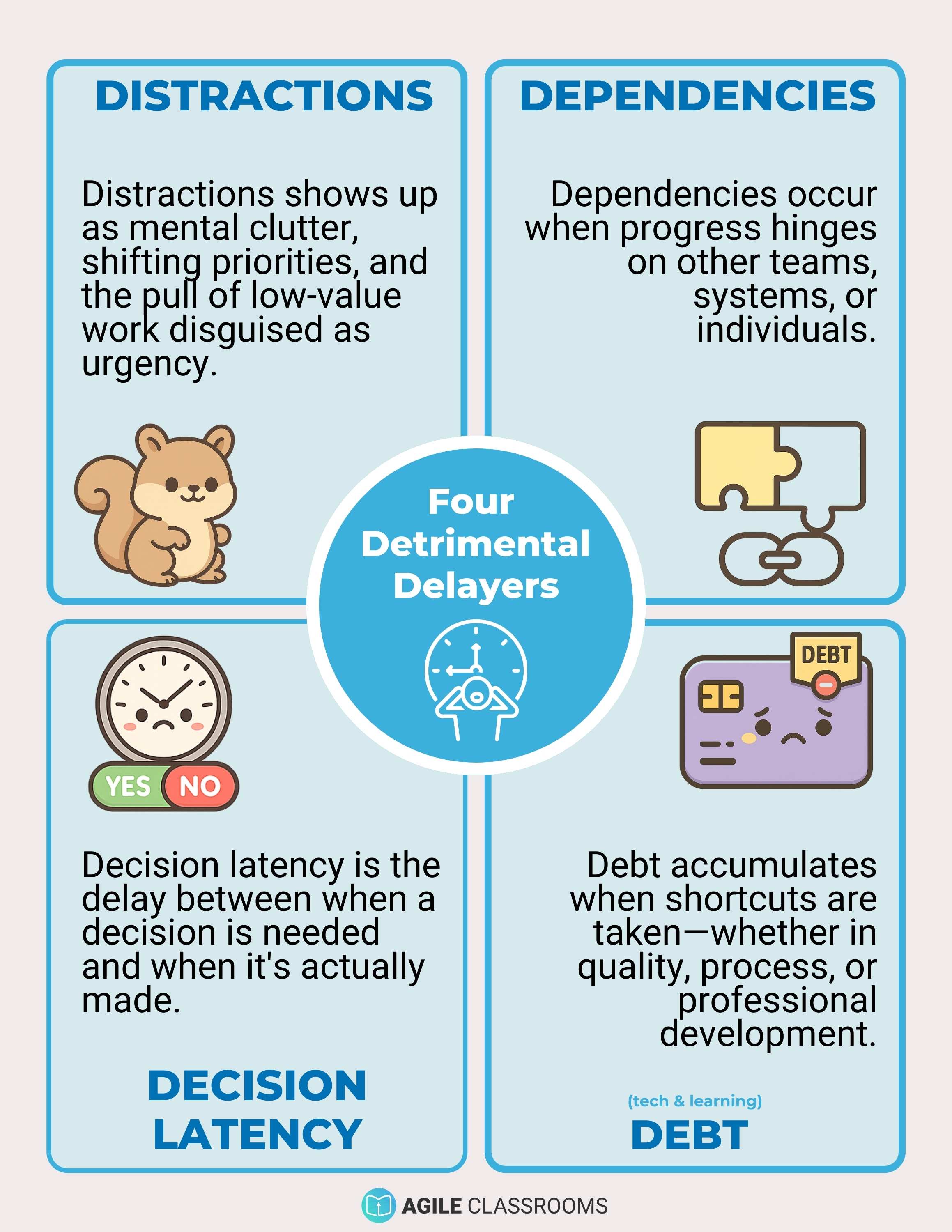
📌 Download the infographic and worksheet: https://learn.agileclassrooms.com/detrimental-delayers
1. Distractions 🐿️
Distractions show up as mental clutter, shifting priorities, and the pull of low-value work disguised as urgency.
They come in many forms:
Constant interruptions
Context-switching between projects
Chasing shiny new ideas instead of focusing on core goals
📚 What research says: 70% of employees report feeling distracted at work. The average worker is interrupted every 11 minutes and takes 25 minutes to refocus. "Attention residue" lingers even after interruptions, impairing focus and work quality.
What to do:
Build a culture of focus
Communicate clear priorities
-
Use time blocking and task batching to reduce context-switching and protect deep focus
Task batching means grouping similar types of tasks (like replying to emails or reviewing documents) together to minimize cognitive switching costs and maintain momentum.
Empower teams to say "not now" to non-aligned work
Establish communication protocols and quiet zones
2. Dependencies 🔗
Dependencies occur when progress hinges on other teams, systems, or individuals.
They limit autonomy and introduce unpredictability. Blockers often stem from unanswered questions, missing info, or external bottlenecks.
📚 What research says: Dependencies and blockers create cascading delays and raise costs. Unclear requirements, outdated systems, or lack of access all contribute to slowdowns.
What to do:
Map all dependencies during planning
Use blockers trackers and early warning systems
Reduce external reliance by redesigning workflows
Prioritize critical path dependencies
Build buffers around risky handoffs
3. Decision Latency 🚦
Decision latency is the delay between when a decision is needed and when it's actually made.
It often stems from unclear authority, slow escalations, or overloaded approvers.
📚 What research says: Projects involve thousands of decisions. Delays in decision-making reduce value and compress timelines. High-impact decisions should happen within a week; smaller ones in 24–48 hours.
What to do:
Track decision latency with risk/issue/action logs
Clarify decision rights and who decides what
Push authority down to teams
Hold regular decision reviews
Use standing meetings for time-sensitive decisions
4. Debt: Technical and Learning 💳
Debt accumulates when shortcuts are taken—whether in quality, process, or professional development.
It slows teams, reduces flexibility, and increases long-term costs.
📚 What research says: Technical debt—especially when unmanaged—makes systems harder to maintain, harder to change, and more unpredictable. Learning debt occurs when skills or customer understanding lag behind current needs.
What to do:
Prioritize technical and learning debt across your systems, processes, and skills
Schedule regular time for refactoring and upskilling
Make debt visible and trackable
Be deliberate about debt tradeoffs using frameworks like Fowler’s Tech Debt Quadrant
Your Action Plan: Remove the Delayers
Step 1: Spot the delayers you can control
Bring the Four Delayers into your next retro.
Ask: Which of these are showing up? What can we shift today?
Use our infographic and guide to spark meaningful discussion.
Step 2: Measure improvements
Use flow metrics like:
Cycle time
Lead time
Work item age
Show how reducing delayers improves delivery. Share results with leadership to build momentum.
Step 3: Engage leadership to tackle what’s beyond your team
Present the internal gains you've made.
Use that evidence to ask for help removing external blockers.
Support your case with:
A3 thinking
Root cause analysis. Nite, while there’s rarely a single root cause, the practice reveals deeper contributing factors. Think of it like tracing a tree’s roots—there are usually many.
Value stream maps
Ask leadership: What will it take to empower us to fix this?
📝 Use the worksheet to identify each delayer’s impact and build your action plan together.
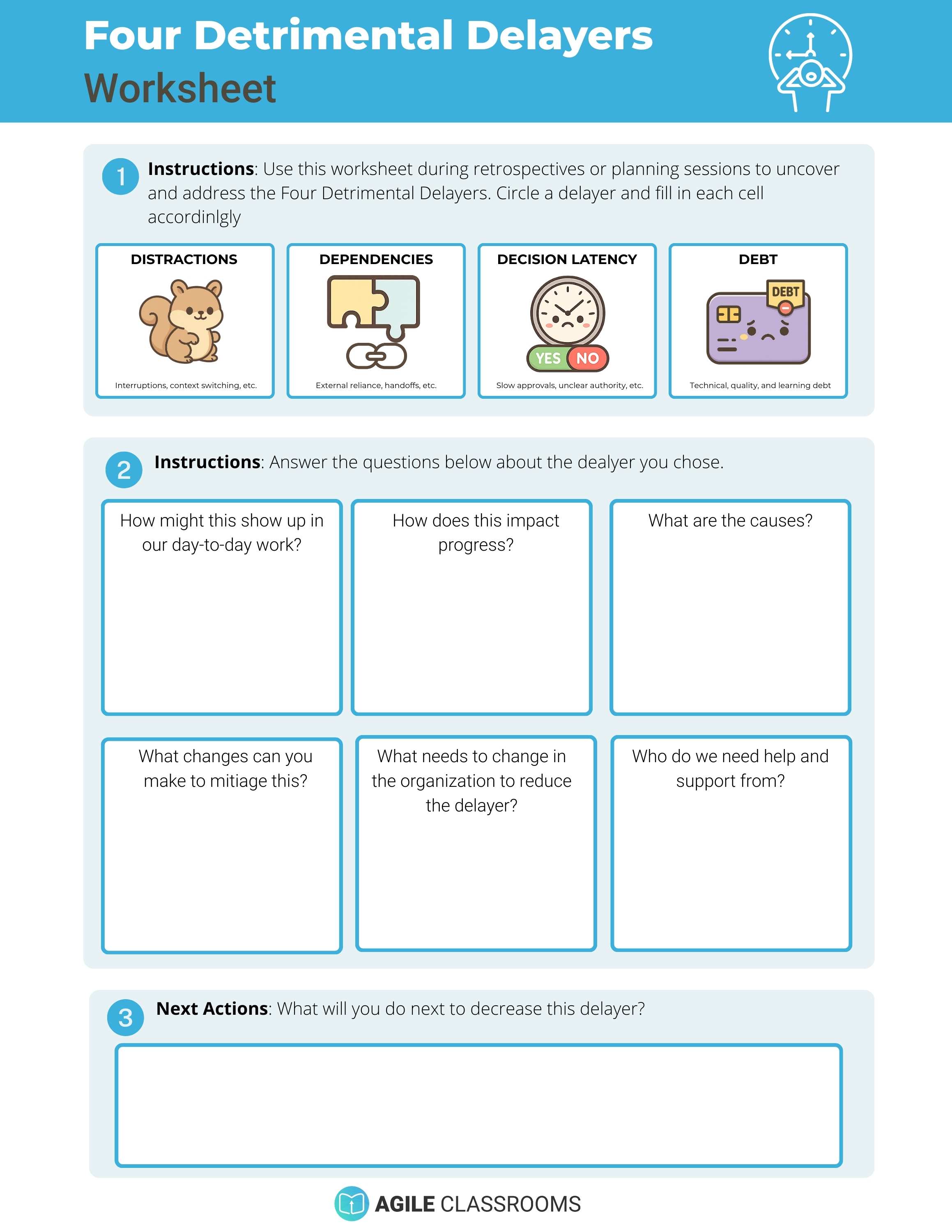
✅ Download the worksheet and use it in your next retro or leadership session.
Facilitate a Conversation
Use these questions in your team retrospective or leadership workshop:
What delayers are affecting us?
How do they show up?
What are the consequences?
Which ones can we tackle right now?
What’s out of our control, and who needs to help?
When you reduce delayers, speed increases—without burning out your team.
You’re not pushing people to go faster. You’re removing what’s slowing them down.
Want to Go Deeper?
Explore this and et hands on with the templates in our Certified ScrumMaster (CSM) — Learn how to remove blockers, manage flow, and foster self-managing teams.
🏅 Earn 0.25 SEUs/PDUs for reading this! Renew your PMP, CSM, or CSPO certification.
PDUS/SEUS
This article counts toward .25 PDUS/CEUS. Get more credits by reading more articles 👉
Enjoyed this post? Let’s keep going.
Whether you're leading a team, managing a product, or transforming a classroom, I have resources to help you work smarter and get real results.
Click below for what works for you:
Free Resources
More Articles
Engaging Workshops
About John
Hey, I’m John. I help leaders, educators, and product innovators work smarter and build things that matter.
I cut through the noise to bring modern methods that actually work. Whether it’s leadership, product management, or education, the goal is the same—less friction, more impact. No fluff. No jargon. Just real-world insights to help you get better, faster.
💡 What You’ll Get Here:
✔ Smarter ways to lead and collaborate without the micromanaging
✔ Fresh, no-nonsense takes on modern work and education
✔ Tools and tactics to make work easier, faster, and more effective
Work doesn’t have to be chaotic.
Let's connect!